
It’s not programming.
It’s not prompt engineering.
It’s not some vague idea of “collaborating with AI.”
Those are all surface-level skills.
At the core, there’s only one thing that matters:
The ability to ask good questions.
Why Questions Matter More Than Answers
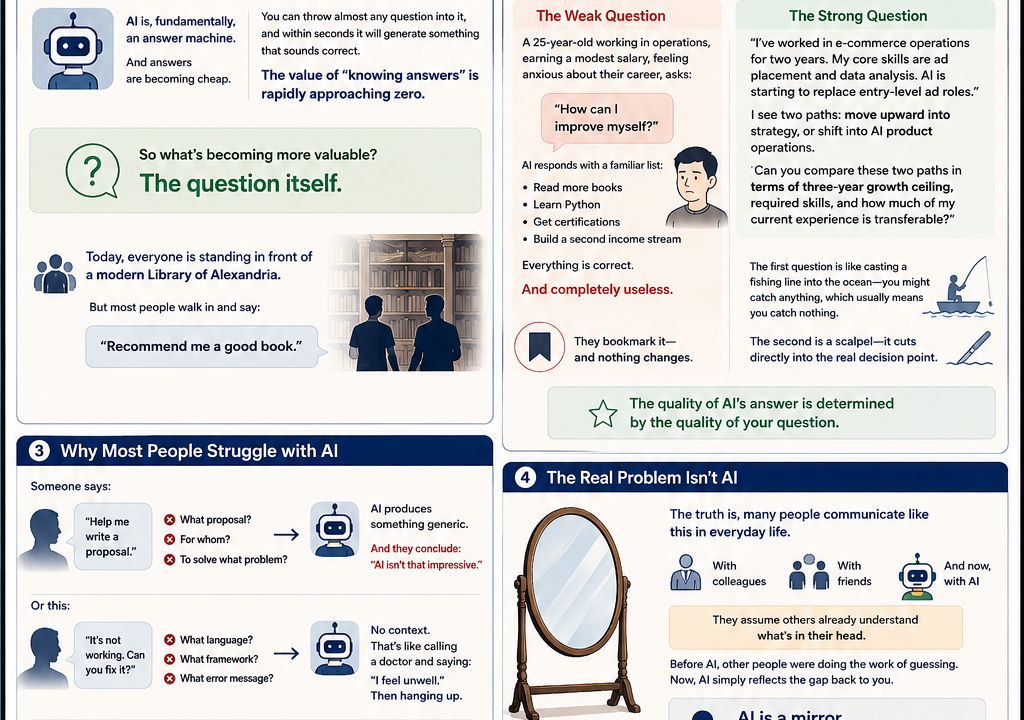
AI is, fundamentally, an answer machine.
And answers are becoming cheap.
You can throw almost any question into it, and within seconds it will generate something that sounds correct. The value of “knowing answers” is rapidly approaching zero.
So what’s becoming more valuable?
The question itself.
Today, everyone is standing in front of a modern Library of Alexandria.
But most people walk in and say:
“Recommend me a good book.”
A Simple Comparison
Let me show you the difference.
A 25-year-old working in operations, earning a modest salary, feeling anxious about their career, asks:
“How can I improve myself?”
AI responds with a familiar list:
-
Read more books
-
Learn Python
-
Get certifications
-
Build a second income stream
Everything is correct.
And completely useless.
They bookmark it—and nothing changes.
Now compare that to a better question:
“I’ve worked in e-commerce operations for two years. My core skills are ad placement and data analysis. AI is starting to replace entry-level ad roles. I see two paths: move upward into strategy, or shift into AI product operations. Can you compare these two paths in terms of three-year growth ceiling, required skills, and how much of my current experience is transferable?”
The first question is like casting a fishing line into the ocean—you might catch anything, which usually means you catch nothing.
The second is a scalpel—it cuts directly into the real decision point.
The quality of AI’s answer is determined by the quality of your question.
Why Most People Struggle with AI
Honestly, watching how many people use AI is exhausting.
Someone says:
“Help me write a proposal.”
What proposal?
For whom?
To solve what problem?
Nothing is specified.
AI produces something generic.
And they conclude: “AI isn’t that impressive.”
But think about it:
If you walk into a restaurant and say, “Just give me something to eat,”
can you really blame the chef when you don’t like the dish?
Or this:
Someone pastes a piece of code and says:
“It’s not working. Can you fix it?”
What language?
What framework?
What error message?
No context.
That’s like calling a doctor and saying:
“I feel unwell.”
Then hanging up.
How is anyone supposed to help?
The Real Problem Isn’t AI
The truth is, many people communicate like this in everyday life.
-
With colleagues
-
With friends
-
And now, with AI
They assume others already understand what’s in their head.
Before AI, other people were doing the work of guessing.
Now, AI simply reflects the gap back to you.
AI is a mirror.
It doesn’t make your thinking worse—it reveals how unclear it already was.
So What Should You Learn?
Stop asking:
“What should I learn in the age of AI?”
Start with something more basic:
**Learn to express your thoughts clearly.
Learn to define your problems precisely.
Learn to ask better questions.**
That’s the real leverage.
Final Thought
Before trying to master AI—
Learn to speak clearly.

CADOAN is a professional, independent AI industry blog and information platform dedicated to the research, sharing, and popularization of artificial intelligence. We are a team of AI enthusiasts, researchers, and technical writers who focus on the development and application of modern artificial intelligence. We do not represent any commercial institution, technology company, or AI model camp. Our only position is to provide real, objective, and valuable AI content for readers, learners, developers, and business practitioners around the world.
No Comments