
AI has finally gotten a permanent memory. Overnight, the memory system called ASMR shocked the entire industry. On the hardest AI memory test, it broke the SOTA record with a 99 percent score. The whole internet is calling it crazy.
This is the memory problem that has plagued AI for years.

Yesterday, a team called Supermemory dropped a bombshell on the tech world. They released a new memory system called ASMR.
On the hardest long-term memory test for AI, called LongMemEval, ASMR scored 99 percent accuracy.
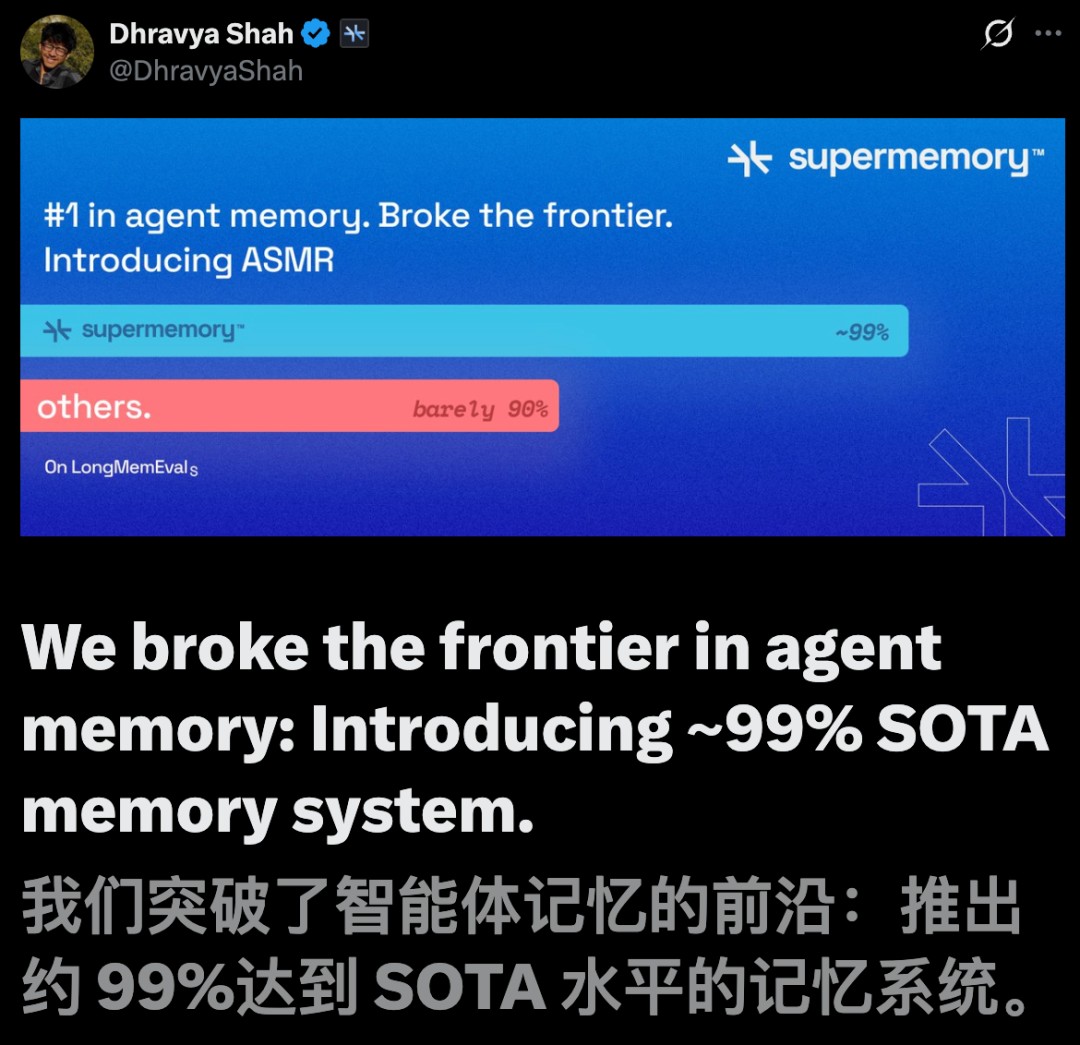
This could change how every AI agent works. It could finally cure the memory loss problem that has haunted AI for years.
And yes, this is real.
ASMR broke the SOTA record on LongMemEval. The news spread fast on X and across the web.

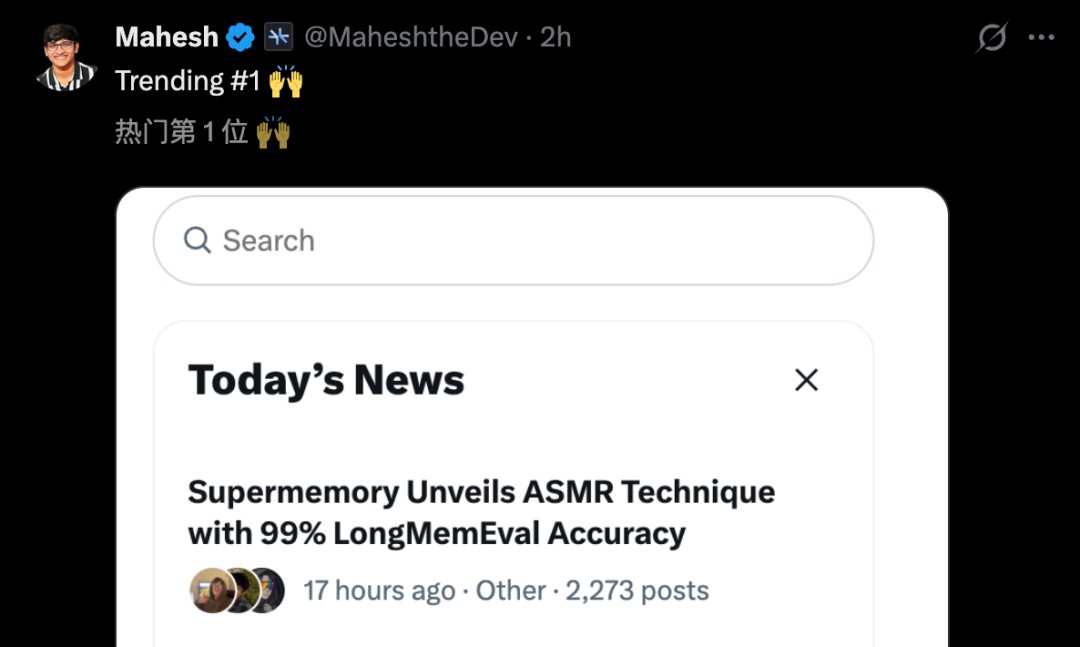
It is completely different from the old vector database and embedding approach. This is a full in-memory storage system.
For the first time, ASMR does not rely on vector search. It uses a team of AI agents working together like a pipeline.
Three observer agents read the raw data. They extract key facts, remove bias, and fix timeline errors.
When a user asks a question, three answer agents work together to find the right response.
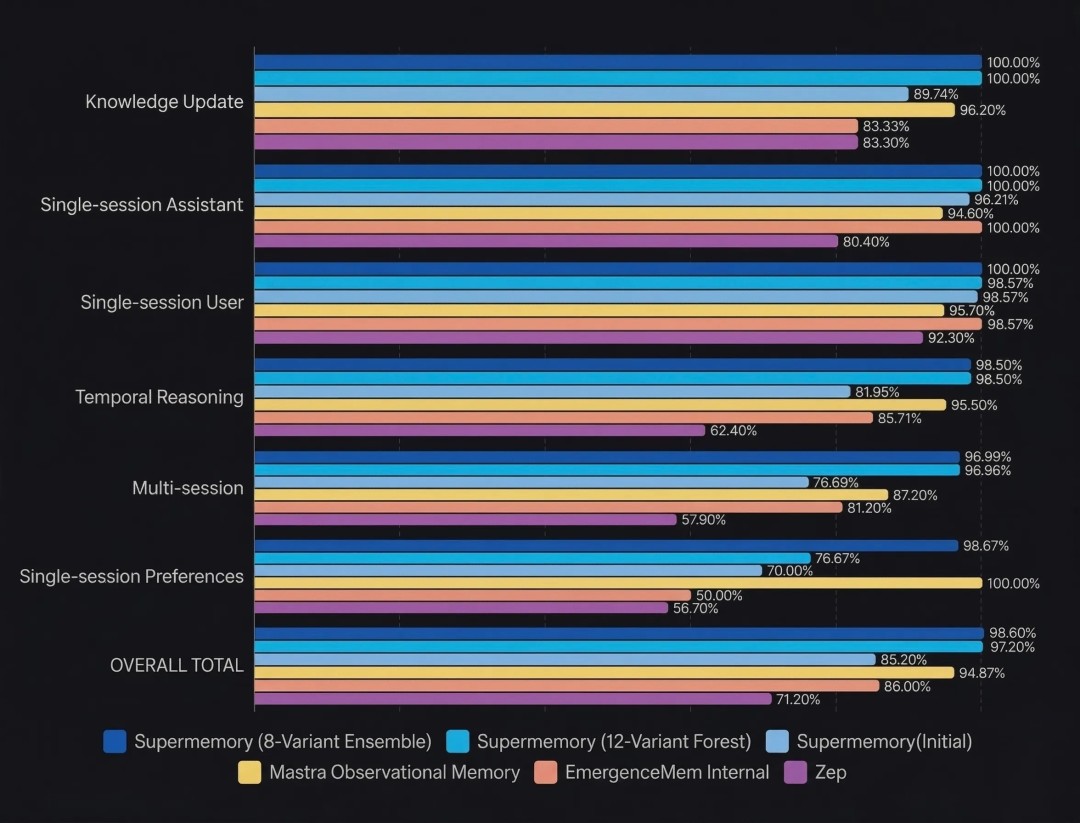
The results are stunning. It broke the record.

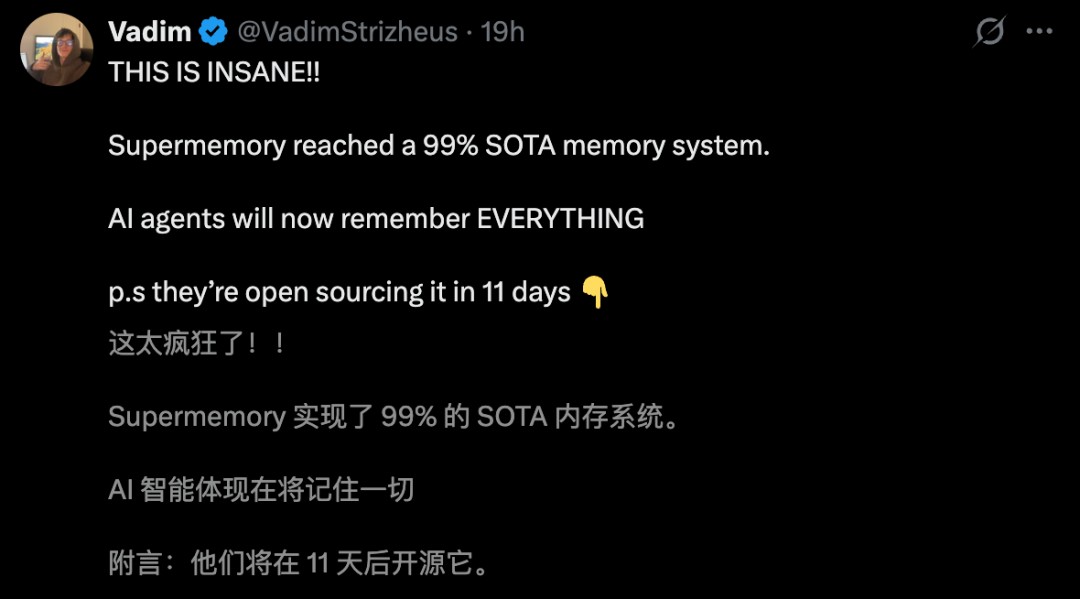
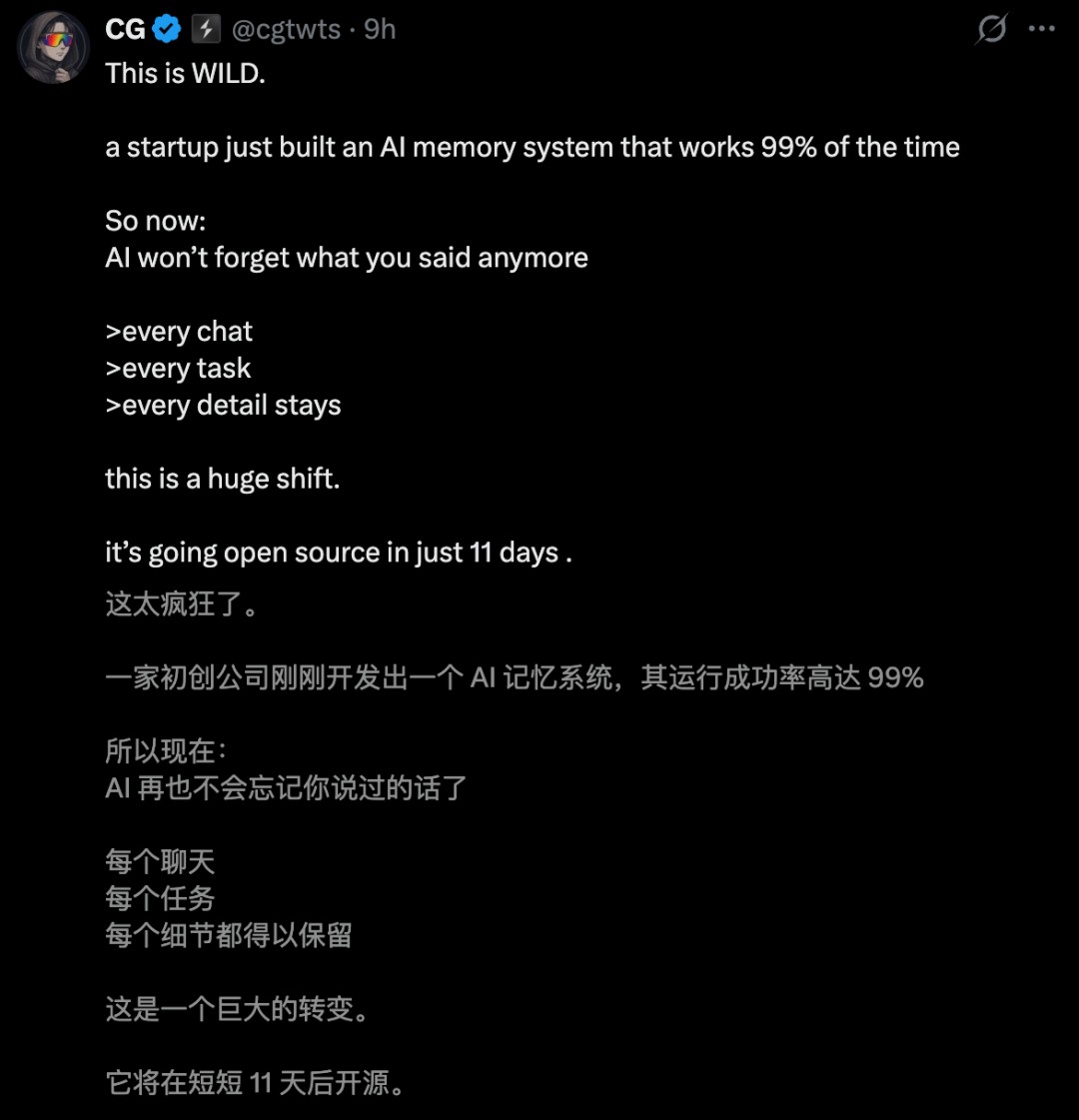

Click to view the full image.
What is even more exciting is that ASMR is fully open source. It has entered the ocean of AI memory in a completely new way.
 Overnight AI Gets a Permanent Memory
First, let us mark the first sentence of this post.
The memory problem of AI agents has been completely solved.

One month ago, the Supermemory team released a research paper. They scored 85 percent on LongMemEval-s. That was already the best in the world at the time.
But yesterday, their new memory system ASMR shocked everyone. It broke the world record again.
The core idea is simple. No vector database. No embeddings. Just pure in-memory storage.
This means that in the ASMR system, data is stored in raw text form. It is like writing on a hard drive.
So how does ASMR find the right answer from all this text?

How ASMR Uses Agents to Find Answers
You need to know that LongMemEval is one of the hardest long-term memory tests in the world.
Most benchmarks only test simple short-term memory. LongMemEval is different. It tests real-world complex memory tasks.
It uses 11.5 million tokens of chat history. The conversations are full of conflicting information, scattered events, and timeline errors.
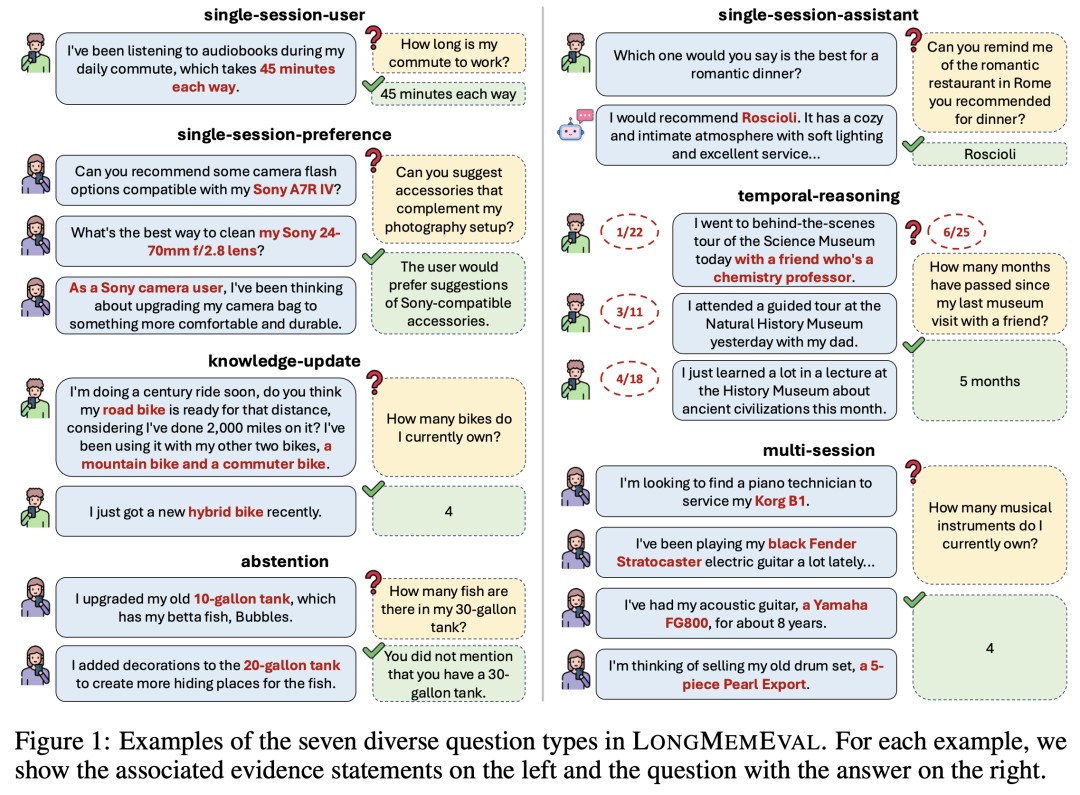
The old memory systems had three big problems. They lost information. They got confused. They made mistakes.
Even with high recall rates, when an LLM reads all that information, it gets overwhelmed. It cannot tell which facts are right and which are wrong. It cannot judge if the information is outdated.
To solve this, the Supermemory team came up with a new idea. They used a team of agents to read and verify the memory.
This is why the team moved beyond traditional RAG. They built a new pipeline where agents work together.
 The 3 Plus 3 Agent Team
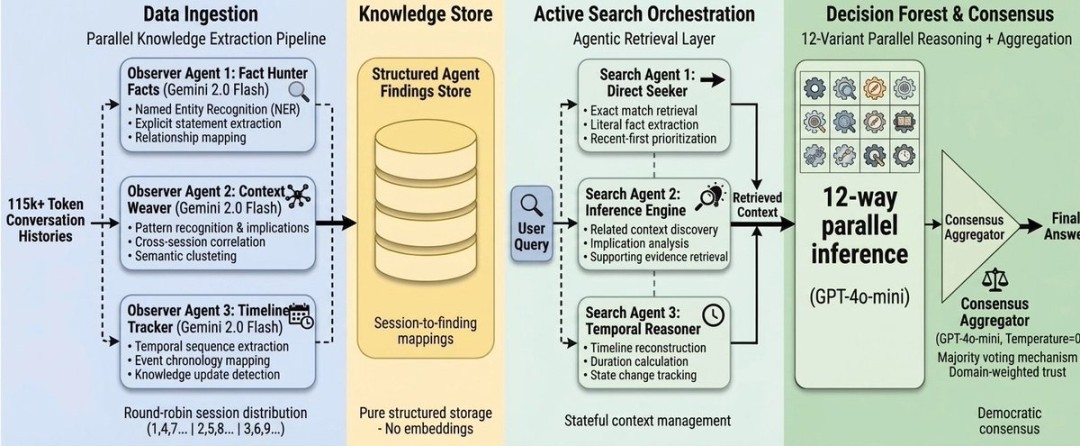
The core tech of ASMR is simple but powerful. It uses a 3 plus 3 agent team.
Step One. Three Observer Agents Read the Data
First, three observer agents read the raw conversation history. They are powered by Gemini 2.0 Flash.
These agents split the chat history into chunks. Then they read and extract key facts from each chunk.
For example, Agent 1 reads conversations 1, 3, and 5. Agent 2 reads 2, 4, and 6.
The observer agents look for facts, relationships, knowledge, bias, timeline errors, and missing information.
Of course, these structured facts are then stored back in the source conversation.
Step Two. Three Answer Agents Find the Response
When a user asks a question, ASMR queries the memory database.
It uses three answer agents. Each agent reads the stored facts and focuses on a different angle.
Agent 1 looks for direct facts and hard data.
Agent 2 looks for social context, relationships, and soft hints.
Agent 3 looks for timeline errors and relationship maps.
After all three agents finish reading, they compare their findings. They verify the facts against the original conversation.
The system uses semantic knowledge and keyword matching to find the best answer.
If all three agents agree, the answer is marked as correct.
Some questions need deep thought. Some need broad search. Some need precise answers.
This is how Supermemory uses a team of AI agents to solve the memory problem.
 ai porn free
Eight Experts Vote with 98.6 Percent Accuracy
To make sure the answer is right, ASMR uses eight expert agents. They act like a jury.
Each expert has a different skill. Some are good at deep context. Some clothes remover ai are good at fact checking. Each one gives its own score.
On eight different paths, if any path finds the correct answer, the whole system marks it as correct.
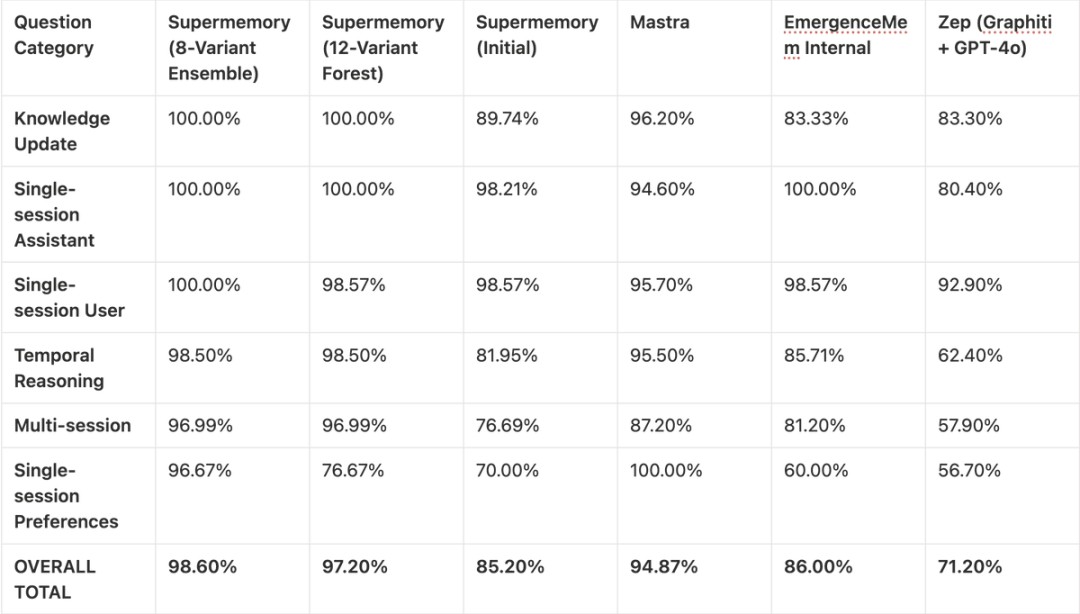
In the final vote, ASMR reached an incredible 98.60 percent accuracy. This is a new world record.
Twelve Experts Vote with 97.2 Percent Accuracy
To test the system even more, the team expanded ASMR to a jury of twelve expert agents.
Here, twelve expert agents powered by GPT-4o-mini were used as the jury.
The final answer comes from a large model that combines all the votes.
The combined model, using the same data, reached an amazing 97.2 percent accuracy.
It is important to say that ASMR is not just a research project. It is already part of the Supermemory product.
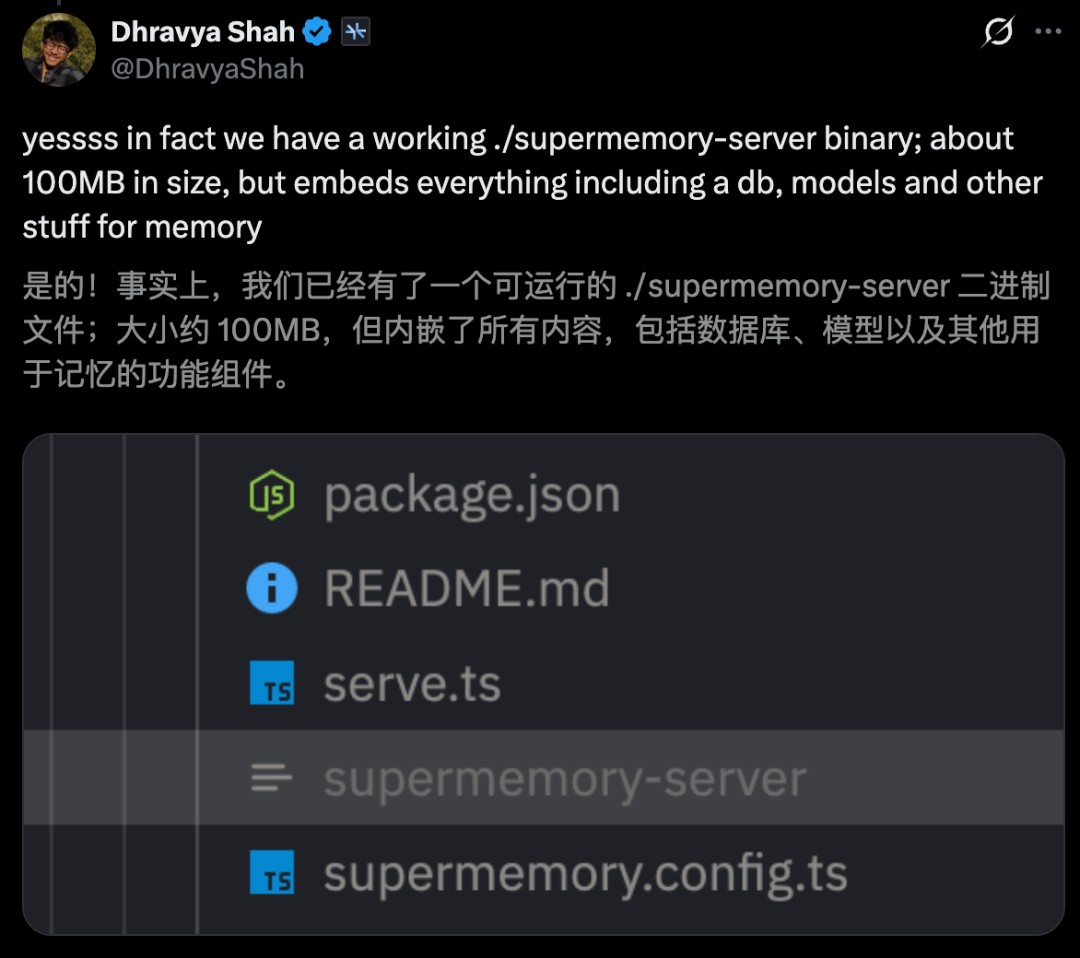
The experiments prove a key point. It is not about the data. It is about the method.
 Supermemory Is More Than Just Memory
Some people think ASMR is just a research project that is too small. But they are wrong.
ASMR is just one part of Supermemory. The bigger picture is a full-stack AI application with memory at its core.
Your AI forgets everything between conversations. Supermemory fixes that.

GitHub link: https://github.com/supermemoryai/supermemory

Beyond RAG. A True Memory System
As we said, ASMR is not just about finding the right info from a chat. Supermemory wants to give AI a real memory, not just a search tool.
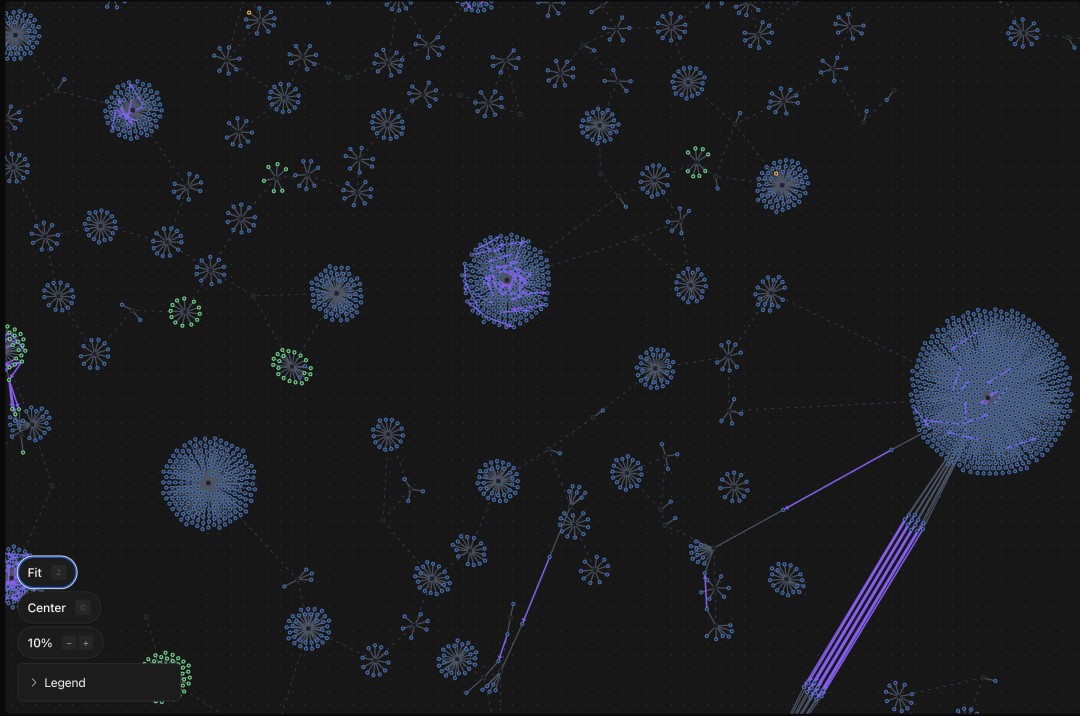
Right now, RAG is dead. The old way of searching vector databases and returning chunks of text is too slow. Supermemory reads from conversation history in real time. It tracks changes, handles conflicts, and updates itself.
For example, if you tell the AI “I moved to Shanghai last week” and then ask “Where do I live now,” a RAG system might return old info. Supermemory knows you moved. It says “Shanghai.”
The key is auto-updating memory. As the conversation grows, the memory updates in real time. Old info is marked as outdated. New info is added.
Supermemory combines RAG and memory into one query. Knowledge graphs and conversation history work together.
One API Call. Full User Profile in 50 Lines
Beyond memory, Supermemory has also upgraded the user profile system.
Traditionally, building a user profile system meant manual tagging, bias, and history tracking. Supermemory does all of this automatically.
With one API call and about 50 lines of code, the agent knows who you are.
The system prompt automatically switches between stealth mode and open mode based on the user.

Full Suite Data Import
Beyond chat memory, Supermemory connects to external data sources.
Google Drive, Gmail, Notion, OneDrive, and GitHub all sync in real time through webhooks.
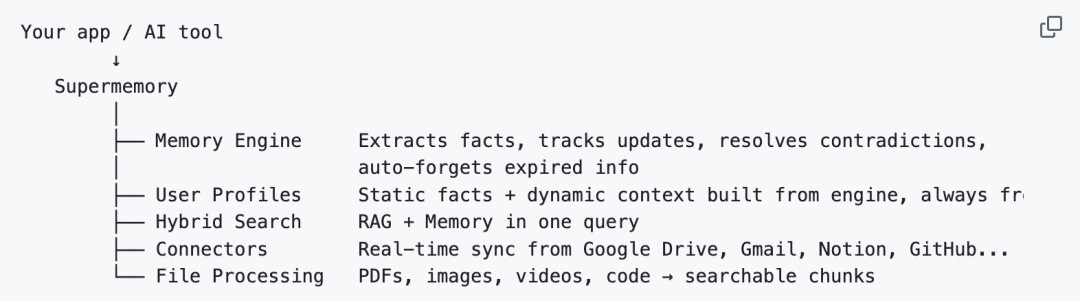
File uploads are automatic. PDF parsing, image OCR, video transcription, and code AST parsing are all built in. No extra setup needed.
For developers, the cost is low and the setup is simple.
Install with npm. Write a few lines of code. Connect to your own agent. It works with Vercel AI SDK, LangChain, LangGraph, OpenAI Agents SDK, and Mastra. It is a full wrapper for the AI ecosystem.
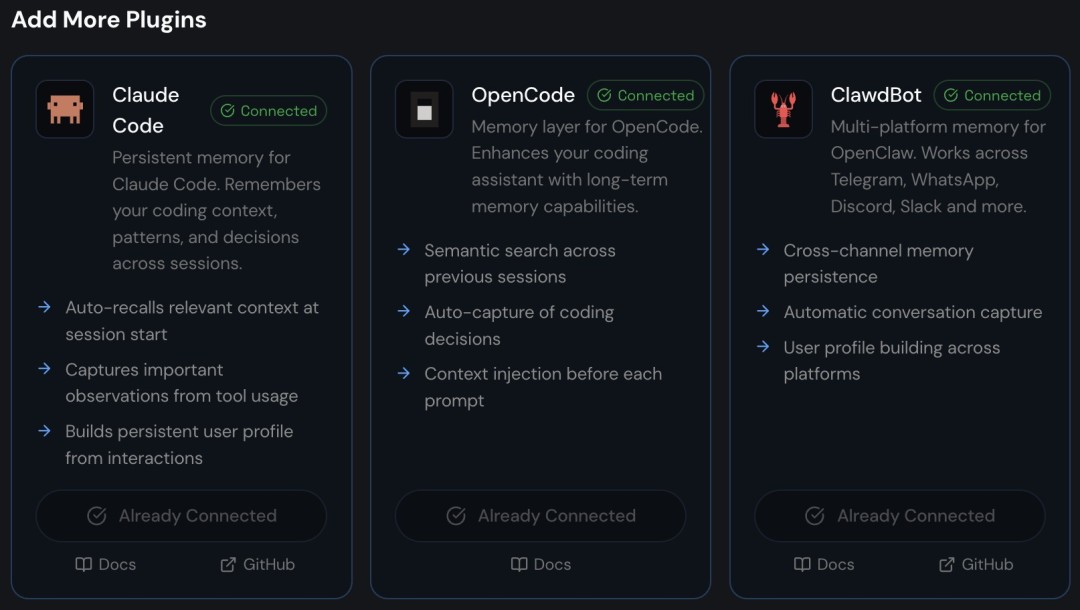
It also supports Claude Code, OpenCode, and OpenClaw.
And the code is small.
Supermemory provides an MCP server. One click install. Works with Claude Desktop, Cursor, Windsurf, and VS Code.
 This Is Just the Beginning
From experiments to product, the Supermemory team proved one thing. Permanent memory for AI is not just a feature. It is a full infrastructure.
In the past year, the model race was about context length and inference speed. The next race is about memory.
When context windows grow to 128K, conversations become long. But the next time you chat, the AI still forgets.
Right now, AI is like a puzzle. Each piece is a conversation. But every agent can only remember the current piece. It forgets who you are, what you said, and what you need.
When you come back after a week, the AI treats you like a stranger.
Now that AI has a memory, it will never forget again.

CADOAN is a professional, independent AI industry blog and information platform dedicated to the research, sharing, and popularization of artificial intelligence. We are a team of AI enthusiasts, researchers, and technical writers who focus on the development and application of modern artificial intelligence. We do not represent any commercial institution, technology company, or AI model camp. Our only position is to provide real, objective, and valuable AI content for readers, learners, developers, and business practitioners around the world.