
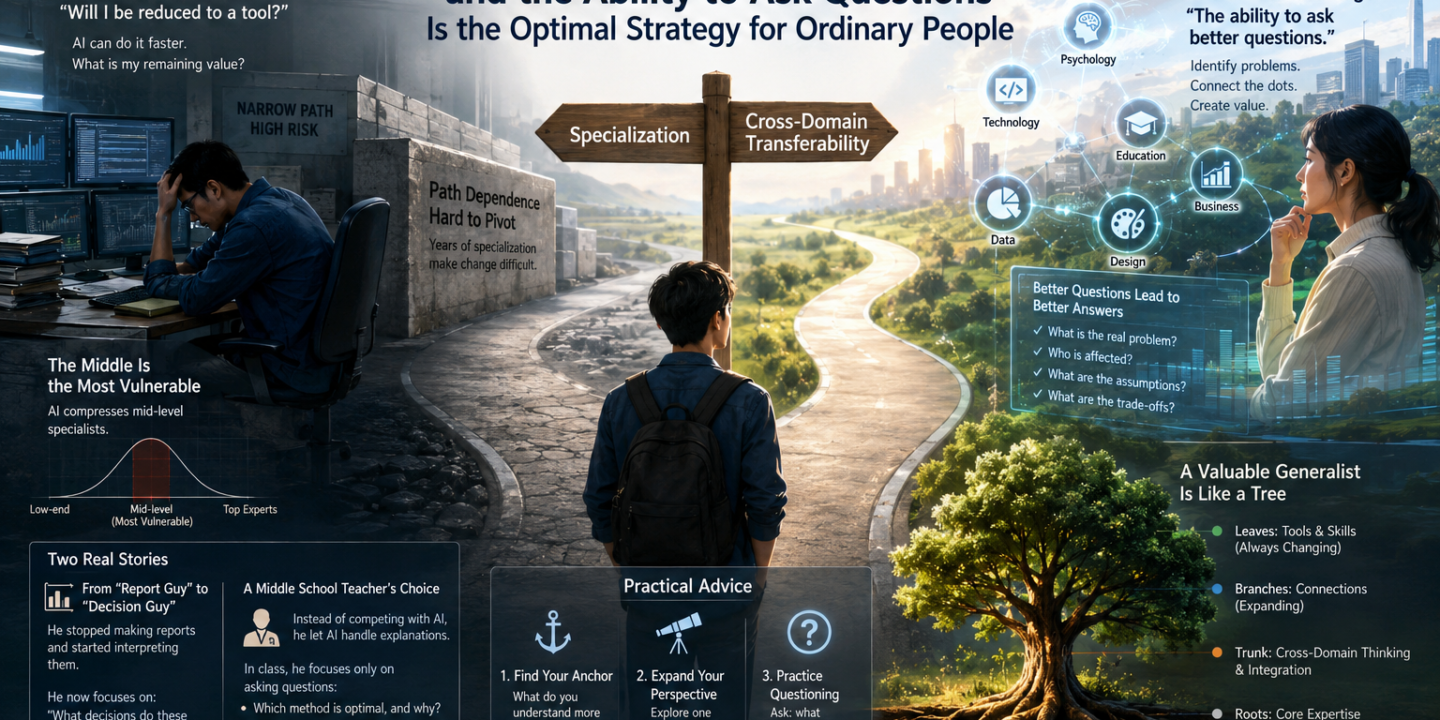
This is not a “neutral” suggestion. It is a judgment that takes a side.
1. A Question That Kept Me Awake
Last winter, at an AI industry forum in Hangzhou, I encountered a question that kept me awake all night.
The theme of the forum was “AI Empowering All Industries.” On stage stood an entrepreneur producing AI-generated short dramas. He said his team of just three people could produce 200 short videos per month. In the audience sat a man who had spent 20 years in film post-production. His face turned grim as he listened.
During the coffee break, he came up to me and asked:
“Mr. Li, do you think the 20 years I spent mastering editing were all for nothing?”
I froze for a moment. His anxiety was so real that I couldn’t find the right words.
But that question lingered with me for an entire week.
Because I knew that behind his question was a bigger one—one sweeping across everyone:
In the age of AI, what should ordinary people bet on?
I’ve been asked this countless times over the past year—by young engineers, professors, my cousin who works in content creation, even my father who believes “AI is just an advanced search engine.”
Different contexts, same anxiety:
-
Is what I’ve learned still worth deepening?
-
Should I switch careers and learn “real technical skills”?
-
What kind of people will the future workplace need?
I didn’t have an immediate answer. But after a week of reflection, I figured something out.
This article is that answer.
2. A Counterintuitive Insight
Here’s something counterintuitive:
Both generalists and specialists are anxious—but their outcomes differ.
The Specialist’s Anxiety: “Will I be reduced to a tool?”
A friend of mine—let’s call him “Report Guy”—has spent eight years specializing in financial report automation. From Excel VBA to Python pandas to Power BI, he became a top expert in his niche.
Last year, he excitedly told me about an AI tool that could automatically generate financial reports and detect anomalies.
“This is great—my efficiency will increase tenfold!”
Three months later, we met again. His mood had changed.
“Now every intern in our department can use that tool. My eight years of experience feel like they’ve turned into just ‘clicking buttons.’”
“What took me eight years to master, AI made accessible to everyone in three months. So how much is my remaining 20% worth?”
That’s the specialist’s dilemma:
Not “Will I still be needed?” but “Will I be needed in a completely different way?”
And worse—he can’t easily pivot. Years of path dependence make it difficult to become something else.
The Generalist’s Anxiety: “Am I not truly good at anything?”
Another friend—let’s call her “Cross-Disciplinary”—studied psychology, then human-computer interaction, worked as a product manager, then in user research, and now designs learning experiences at an AI education company.
She often jokes:
“I know a little about everything, but I’m not deeply skilled in anything.”
Recently, a new colleague joined—a recent computer science graduate specializing in large-model fine-tuning. Within three months, he built a system that could automatically generate personalized learning paths.
Her first reaction: excitement.
Her second: panic.
“Do I need to learn ‘real technical skills’ too?”
I asked her:
“Do you think that colleague can design a learning experience that keeps students engaged long-term?”
She paused, then laughed:
“Probably not.”
The key point: a generalist’s anxiety is solvable, because cross-domain ability itself is a moat.
3. An Experiment That Changed My Mind
I gave seven people the same task: use AI to design a career-planning assistant for college students.
Their backgrounds included: a computer science graduate, a 10-year HR manager, psychology + product manager, philosophy PhD + content creator, teacher + hobbyist programmer, sales, and administrative staff.
The results were surprising.
-
Worst outputs: sales and admin. They simply asked AI to generate a chatbot and copied the output. The issue wasn’t using AI—it was shallow questioning.
-
Standard outputs: the engineer and HR manager. Technically solid, but limited in perspective.
-
Best outputs: interdisciplinary thinkers. They asked better questions:
-
What anxieties do students face?
-
Who defines a “good” career?
-
How do we ensure students feel ownership of their plans?
-
These were not technical questions—they were structural ones about people, values, and systems.
The real difference wasn’t expertise. It was who could ask the right questions.
And that is precisely where generalists excel.
Specialists are trained to produce correct answers—something AI already does well.
Generalists are trained to identify meaningful questions—something AI struggles with.
So value is shifting—from answers to questions.
4. Why Specialization Is Becoming Less Cost-Effective
This doesn’t mean expertise is unimportant. It means the bar is getting higher.
AI:
-
Amplifies top experts.
-
Compresses mid-level specialists.
Lower-level specialists can reach 80% competence quickly with AI.
Top-tier experts become even stronger.
But most people sit in the middle—and that’s the most vulnerable position.
Worse, specialists often have narrow transition paths.
So instead of competing in an increasingly constrained track, a better strategy is:
Build cross-domain capability as your moat.
5. Why Breadth Matters More
AI tools now enable individuals to perform across domains.
-
A writer can generate visuals.
-
A salesperson can analyze data.
-
An HR manager can build hiring systems.
Efficiency improves—but expectations also rise.
Previously, you only needed to master your own domain.
Now, you must understand how adjacent domains work to effectively use AI.
Example:
If you ask AI:
“Why did team performance decline?”
You’ll get vague answers.
But with basic financial literacy, you can ask:
-
What happened to output per employee?
-
Which projects reduced ROI?
Better questions lead to actionable answers.
That is the power of cross-domain knowledge.
6. What Makes a Valuable Generalist
A generalist is not someone who knows a little of everything.
A true generalist:
Transfers methods across domains.
Think of it as a tree:
-
Roots: your core expertise and judgment.
-
Trunk: cross-domain thinking and integration.
-
Branches: expanding connections.
-
Leaves: tools and skills (constantly changing).
Leaves fall. Roots and trunk remain.
7. Practical Advice
You don’t need to quit your job or enroll in courses.
-
Step 1: Find your anchor.
What do you understand more deeply than most people? -
Step 2: Expand your perspective.
Explore one unrelated field each month. -
Step 3: Practice questioning.
Ask: what assumptions lie behind each answer?
Over time, you’ll begin to see structures others miss.
8. Two Real Stories
From “Report Guy” to “Decision Guy”
He stopped making reports and started interpreting them.
He now focuses on:
“What decisions do these numbers support?”
He became a translator of decisions, not a producer of reports.
A Middle School Teacher’s Choice
Instead of competing with AI, he let AI handle explanations.
In class, he focuses only on asking questions:
-
Which method is optimal, and why?
-
What happens if conditions change?
-
What principle is behind this solution?
Students shifted from solving answers to thinking critically.

CADOAN is a professional, independent AI industry blog and information platform dedicated to the research, sharing, and popularization of artificial intelligence. We are a team of AI enthusiasts, researchers, and technical writers who focus on the development and application of modern artificial intelligence. We do not represent any commercial institution, technology company, or AI model camp. Our only position is to provide real, objective, and valuable AI content for readers, learners, developers, and business practitioners around the world.
No Comments