
Using AI well doesn’t depend entirely on how powerful the model is.
The real difference is more about how people use it.
Here are five very practical AI usage tips:
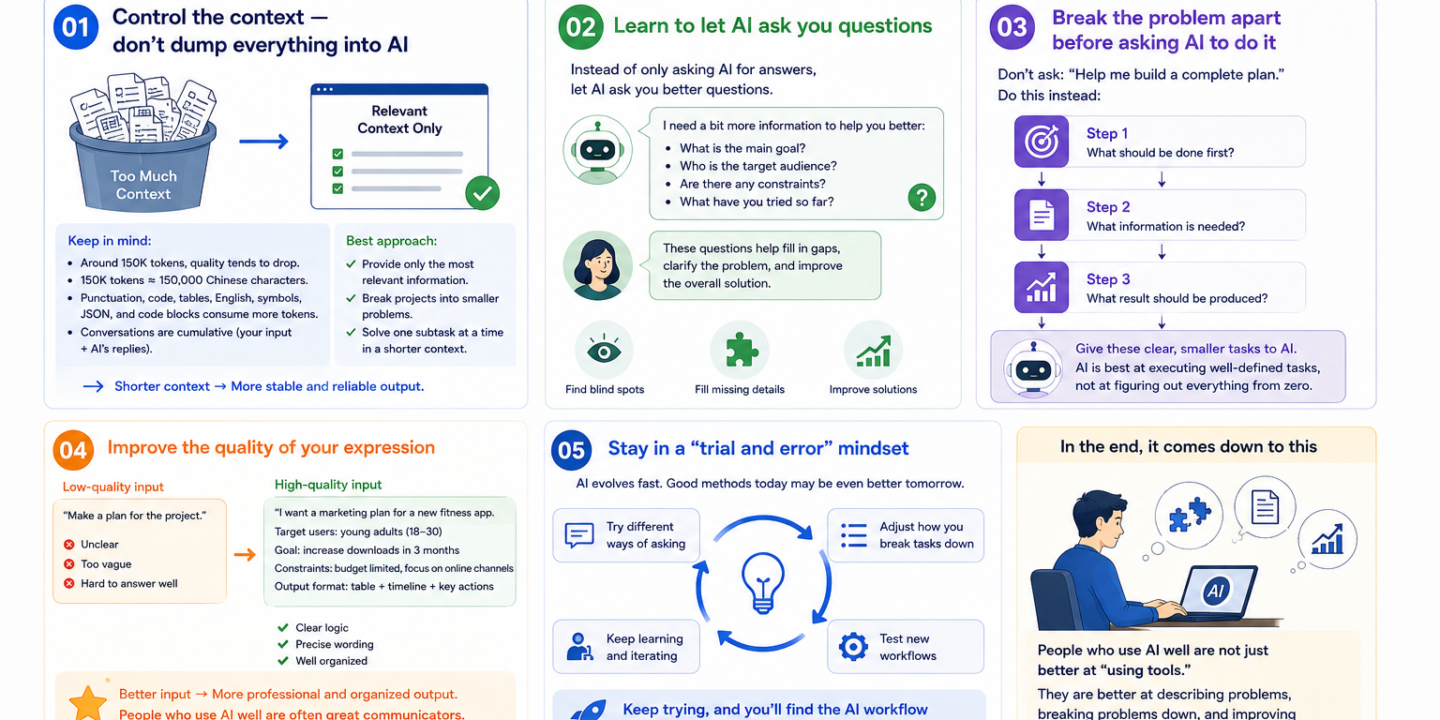
1. Control the context — don’t dump everything into AI
Modern large models can handle very long contexts, but in real use, you’ll often notice that when the context gets close to around 150K tokens, the quality of the answers tends to drop noticeably.
A few things to keep in mind:
-
150K tokens is roughly 150,000 Chinese characters’ worth of content.
-
In real AI usage, punctuation, code, tables, English text, symbols, JSON, and code blocks all consume more tokens than plain text.
-
Conversations are cumulative: the context includes not only what you type, but also the AI’s previous replies.
So even if a model claims to support 200K tokens, many people still try to keep practical tasks within about 100K–150K tokens, because the output is usually more stable in that range.
The right approach is:
-
Only provide the most relevant information for the current problem.
-
Split a project into multiple smaller problems.
-
Solve one subtask at a time in a shorter context.
That usually makes the AI output much more reliable.
2. Learn to let AI ask you questions
A lot of people only use AI to answer questions, but there’s a much better trick:
Let the AI question you.
For example:
-
What key information is still missing from this plan?
-
Is there anything unclear in how I described this requirement?
-
What other directions could we optimize this in?
This helps AI surface blind spots, fill in missing details, and improve the overall quality of the solution.
3. Break the problem apart before asking AI to do it
Don’t throw a complex problem at AI all at once, like: “Help me build a complete plan.”
A better way is to break it down yourself first:
-
Step one: what should be done first?
-
Step two: what information is needed?
-
Step three: what result should be produced?
Then give those clear smaller tasks to AI.
AI is best at executing well-defined tasks. It is not as good at figuring out the whole thing from zero on its own.
4. Improve the quality of your expression
The quality of AI output depends a lot on the quality of your input.
If your description is:
-
logically clear,
-
worded precisely,
-
structurally well organized,
then the AI’s answer is usually more professional and better organized too.
People who use AI well are often people who already communicate well.
5. Stay in a “trial and error” mindset
AI changes fast. Many methods that used to be weak now work very well.
People who really know how to use AI usually keep experimenting:
-
trying different ways of asking,
-
adjusting how they break tasks down,
-
testing new collaboration workflows.
Keep trying, and eventually you’ll find the AI workflow that fits you best.
In the end, it comes down to this
People who use AI well are not just better at “using tools.”
They are better at describing problems, breaking problems down, and improving their methods over time.

CADOAN is a professional, independent AI industry blog and information platform dedicated to the research, sharing, and popularization of artificial intelligence. We are a team of AI enthusiasts, researchers, and technical writers who focus on the development and application of modern artificial intelligence. We do not represent any commercial institution, technology company, or AI model camp. Our only position is to provide real, objective, and valuable AI content for readers, learners, developers, and business practitioners around the world.
No Comments